

Publications
Les droits des demandeurs de protection internationale LGBTIQ+ en Slovénie
The publication explains the rights of LGBTIQ+ applicants for international protection in Slovenia and their specific vulnerabilities. It reviews EU and national case law, the need for up-to-date country of origin information and special procedural safeguards, and outlines measures for decent living conditions. It criticises the EU Pact on Migration and Asylum for restricting access to protection and calls for safe, legal migration routes based on solidarity and equality.
The Rights of LGBTIQ+ Applicants for International Protection in Slovenia
The publication explains the rights of LGBTIQ+ applicants for international protection in Slovenia and their specific vulnerabilities. It reviews EU and national case law, the need for up-to-date country of origin information and special procedural safeguards, and outlines measures for decent living conditions. It criticises the EU Pact on Migration and Asylum for restricting access to protection and calls for safe, legal migration routes based on solidarity and equality.
How to create your own pool of trainers within LGBTIQ+ and other youth organistations
We hope this manual will be a useful tool for organisations to reflect on how they work with trainers and educators, make strategic decisions that suit their unique situation and needs, and support trainers and educators. As more organisations work with young people from marginalised groups, we hope this manual will trigger reflection and empower organisations to include more trainers and educators from marginalised groups.
Mentoring in Peer Education mentoring scheme for mentors supporting peer educators (from marginalised backgrounds)
The Rainbow Peer Forces project (2022-2024) brought together six countries to introduce peer education into youth work with LGBTIQ+ youth. It developed a manual, resources for organisations and peer educators, and a mentoring scheme to support peer educators from marginalised backgrounds, promoting informed decision-making and peer support across Europe.
Manual about peer support among young LGBTIQ+ people
The aim of the “Youth workers alliance for the development and promotion of youth peer support in the area of youth mental health” (YAPS) project was to create peer support practices that will help mitigate the risks of mental health issues in young LGBTIQ+ people. Several studies and the practical experience of youth workers show that there is a causal link between mental health problems and socio-economic problems among these young people.

Prevention of LGBTIQ+ youth homelessness
Manual for youth workers.
In the course of our work, we draw upon concepts that significantly shape our understanding of the existential challenges faced by young LGBTIQ+ individuals and all the associated risk factors and consequences. Understanding housing exclusion and homelessness is of paramount importance if we are to grasp the complexity and dynamism of inadequate housing situations. Simultaneously, we must take into account certain specific circumstances that accompany LGBTIQ+ individuals and social phenomena that profoundly influence their daily lives and life trajectories.
Volunteering as a tool for inclusive society
Good practices manual.
“Volunteering as a tool for an inclusive society” builds intercultural understanding and solidarity via inclusive volunteerism in local communities. It explores using volunteering to address homophobia, racism and xenophobia in NGOs and communities, and to create inclusive environments with stakeholders. Volunteering by marginalized groups promotes solidarity in and beyond the EU and helps cultivate inclusive organisations.
Recommendations on inclusive volunteering
Between March 2021 and September 2022, five organizations (Youth Initiative for Human Rights Croatia, INAR Ireland, Loesje Berlin, Ljubljana Pride, and Youth Initiative for Human Rights Serbia) collected recommendations on inclusive volunteering, both via an online survey and during physical events. The majority respondents are young people coming from marginalised backgrounds and identities themselves. We collected 2540 responses and 915 recommendations for decision makers. A lot of recommendations were similar so we compiled them in a way to express their core idea.
Inclusive Organisations
Manual for organisational development.
Primarily for youth organisations (youth-led or working with youth), but useful for any organisation, institution or public body seeking to become more inclusive and non-discriminatory towards people with marginalised backgrounds. It offers concrete support for organisational reflection and is for managers, staff, group leaders or volunteers planning and delivering programmes with participants/beneficiaries.
Transforming Hate in Youth Settings
This toolkit helps youth workers transform hate speech/behaviour in youth settings. Hate in words, behaviour and attitudes is violence overlooked; left unchallenged it can normalise and escalate into physical violence. Social media multiplies its impact, yet clarity on what hate speech is and how to address it is limited. It provides concrete, adaptable tools to recognise, challenge and transform it, taking its dehumanising impact seriously.
Transforming Hate in Youth Settings
An educational tool for those working with young people. This manual supports youth workers engaging with young people who express hateful speech/behaviour. It builds awareness of communication and listening, helps create safer youth spaces for learning and change, and supports work with those spreading hate—consciously or not—through transformative practice to change attitudes and behaviours.
Research
In order for us to stand up against different forms of oppression and to claim from responsible institutions the human rights of LGBTIQ+ people in Slovenia, we first need to understand profoundly the real needs, situations and struggles of LGBTIQ+ people. With this purpose our association produces and supports the production of scientific research. We also support our members and colleagues with producing scientific research when their work allows us to monitor and report on the realities lived by LGBTIQ+ people in Slovenia.

Sexually Non-binary Persons and Some Aspects of Their Everyday Life
Authors: Nina Perger and Simona Muršec
The text addresses some specificities of the everyday life of sexually non-binary people with an emphasis on bisexual, pansexual, queer and asexual identities. These identities are, according to the Everyday life of LGBTIQ+ youth study, most common within the youngest age category (under 18) and people with transgender and non-binary gender identities. Furthermore, the article focuses on the degrees to which sexually non-binary people reveal or hide their identity in certain kinds of relationships, as well as on the degrees of hiding their identities with the purpose of avoiding discrimination, violence and/or other negative reactions, especially in the context of education and the relations formed within the educational environment.
Vsakdanje življenje mladih LGBTIQ+ oseb v Sloveniji, ali: “To, da imam svoje jebene pravice!”
Authors: Nina Perger, Simona Muršec and Vesna Štefanec
This is the first survey that has successfully covered a large variety of subgroups of LGBTIQ + communities, which to date have been largely overlooked and exempted from the dominant focus on (young) gays and lesbians. Although experience of repression on the basis of sexual or gender identity is roughly similar, there are also important differences and specificities between diverse sexual and sexual identities, which in the future are to be further explored and analyzed for the purpose of effective addressing and overcoming inequalities. In this respect, research and work represent only one of the first steps towards the warning and highlighting of the diversity of identities and its relevance to the everyday lives of non-heterosexual and non-cis persons.
LGBTIQ+ Youth and Experiences with Violence in Education
Author: Nina Perger
Published in: Ars & Humanitas, 12(1), 88-103. Ars & Humanitas, 12(1), 88-103.
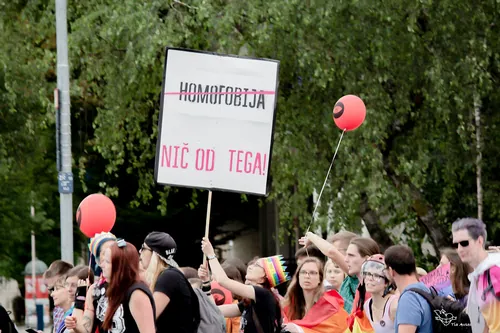
School-worker and peer violence makes normativity explicit, guarding it against those deemed ‘not-at-home’. Their presence in education exposes normativity as arbitrary, while schooling is shaped to form bodies that exclude ‘out-of-placeness’ and prevent its legitimacy from being questioned.